Vusimuzi “Cat” Matlala’s three days before the Madlanga Commission brought fresh scrutiny to his relationships with senior police figures, a controversial SAPS tender and the circumstances surrounding a collapsed plea agreement. His testimony also raised questions about the conduct of investigators and allegations involving former police minister Bheki Cele.
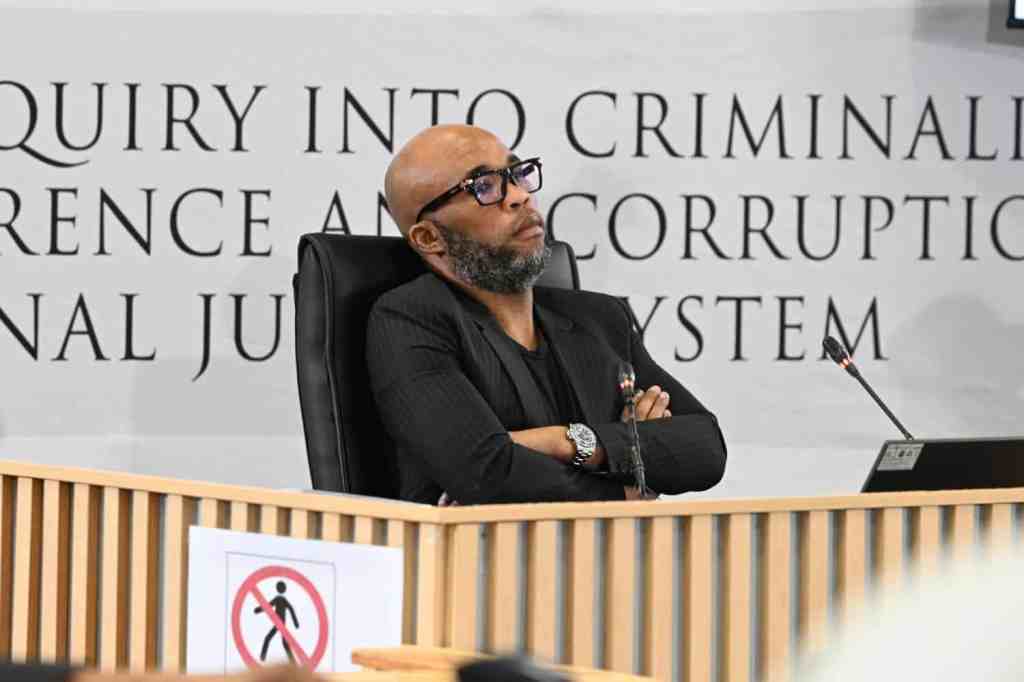
Businessman Vusimuzi “Cat” Matlala concluded three consecutive days of testimony before the Madlanga Commission of Inquiry on Wednesday, 11 November, in proceedings marked by disputed statements, changing accounts of payments and allegations involving senior figures in the South African Police Service (SAPS).
Matlala, who is facing criminal charges linked to the controversial SAPS Medicare24 health-services contract, appeared before the Commission on 9, 10 and 11 November.
His testimony centred on a statement he made as part of a plea-and-sentence agreement with the State, alleged payments to former deputy national police commissioner Lieutenant-General Shadrack Sibiya, and claims involving former police minister Bheki Cele.
The three days also exposed significant disputes between Matlala and investigators from the Investigating Directorate Against Corruption (IDAC) over how his statement was prepared.
The collapsed plea agreement and the Commission’s ruling
The proceedings opened on Monday with a legal dispute over whether the Commission could use Matlala’s Section 204 statement, which formed part of a plea-and-sentence agreement that subsequently collapsed.
In June 2026, Matlala had pleaded guilty to fraud, corruption and money-laundering charges relating to the Medicare24 contract and agreed to become a state witness against his former co-accused.
However, the Pretoria Specialised Commercial Crimes Court rejected the proposed sentence of an effective eight years’ imprisonment, indicating that a longer sentence was appropriate.
Matlala subsequently withdrew from the agreement rather than accept the proposed 12-year effective sentence. The agreement was declared null and void, and his guilty plea fell away.
His legal team argued before the Madlanga Commission that the statement could not be used because it formed part of the failed plea negotiations.
Advocate Annelene van den Heever, representing Matlala, argued that allowing the statement to be used would undermine the protections associated with plea negotiations.
Commission chairperson Justice Mbuyiseli Madlanga ruled that Section 105A(10) of the Criminal Procedure Act relates to criminal proceedings and does not prevent a commission of inquiry from receiving the statement.
The chairperson therefore allowed the Commission to proceed with the evidence, while making it clear that the proceedings would stop if a High Court order setting aside his ruling and interdicting the hearing was received.
Matlala’s legal team indicated that it intended to challenge the ruling.
The ruling did not mean that the statement could automatically be used against Matlala in his criminal trial. The protections applicable to his evidence before the Commission remain relevant.
The disputed R500,000 payment to Sibiya
One of the most significant moments came on Tuesday, when Matlala changed his account of an alleged R500,000 cash payment to former deputy national police commissioner Lieutenant-General Shadrack Sibiya.
On Monday, Matlala denied paying Sibiya R500,000, acknowledging only a separate R50,000 payment linked to travel expenses for the SAPS Excellence Awards in Durban.
However, when questioned again on Tuesday by evidence leader Advocate Thabang Pooe, Matlala admitted giving Sibiya R500,000.
He told the Commission that the money was a contribution towards the wedding of one of Sibiya’s children in the North West.
The alleged handover took place in the basement of the State Theatre in Pretoria.
Matlala maintained that the payment was not connected to the awarding of the Medicare24 contract to his company.
He also acknowledged a separate R50,000 payment for Sibiya’s travel expenses to the SAPS Excellence Awards.
The admission is significant because Sibiya had previously denied receiving money from Matlala.
Matlala declined to explain further why he made the R500,000 payment, citing concerns about the safety of people around him.
The Commission has not made a finding on the payment or the competing accounts.
Allegations involving former police minister Bheki Cele
On Wednesday, the focus shifted to former police minister Bheki Cele, with Matlala disputing parts of his Section 204 statement that implicated the former minister.
Matlala alleged that IDAC investigators had influenced the contents of the statement and exaggerated the amount of money he had allegedly paid Cele.
He disputed a passage suggesting that he had a longstanding association with Cele through the late businessman Jotham Msibi, also known as King Mswazi.
According to Matlala, investigators had wanted him to create a history of interactions between himself, Msibi and Cele.
He told the Commission that he had given Cele money, but maintained that the amount recorded in his statement was exaggerated and that the investigators wanted to build a corruption case against the former minister.
Matlala also gave evidence about alleged cash payments involving Cele.
He described cash withdrawals from a Medicare account, accommodation at his penthouse in Menlyn Maine and an alleged cash handover at the Beverly Hills Hotel in Durban.
However, the precise amounts and sequence of payments were disputed, with Matlala challenging the figure recorded in his written statement.
He further alleged that Cele had asked him to assist with a retirement property in Trafalgar on the KwaZulu-Natal South Coast, valued at approximately R6 million, as well as money for vehicle repairs.
Matlala claimed that he did not fulfil those requests.
He also testified that he had raised concerns about the Political Killings Task Team following a raid on his property and that Cele had undertaken to assist him.
Cele has denied receiving money from Matlala. He has not been charged in connection with these allegations and remains presumed innocent.
What the three days reveal — and what remains unanswered
Matlala’s testimony has brought renewed attention to the relationships between business interests and senior police officials, particularly against the background of the controversial Medicare24 contract.
The contract, awarded to a company linked to Matlala, was advertised at approximately R360 million, with about R228 million reportedly paid.
His evidence also raised questions about the preparation of the Section 204 statement and the conduct of investigators involved in the failed plea negotiations.
However, important issues remain unresolved.
Matlala’s allegations against investigators have not been established as fact. The payments he described have not been determined by the Commission to constitute corruption, and the individuals he named must be afforded an opportunity to respond.
The Commission must also consider the competing accounts and supporting evidence before reaching any conclusions.
Matlala remains an accused person facing criminal proceedings, and the withdrawal of his plea agreement means that the charges against him remain to be determined through the criminal justice process.
His three days before the Commission have added another significant chapter to an inquiry examining alleged criminal infiltration, political interference and corruption within the criminal justice system.
The question now is whether the evidence, documentary records and responses from those implicated will establish a clearer picture of the relationships and alleged conduct under investigation.
The testimony and allegations described in this report are not findings of the Madlanga Commission. All individuals named are presumed innocent unless proven otherwise.


Leave a Reply